verkäuflich / for sale
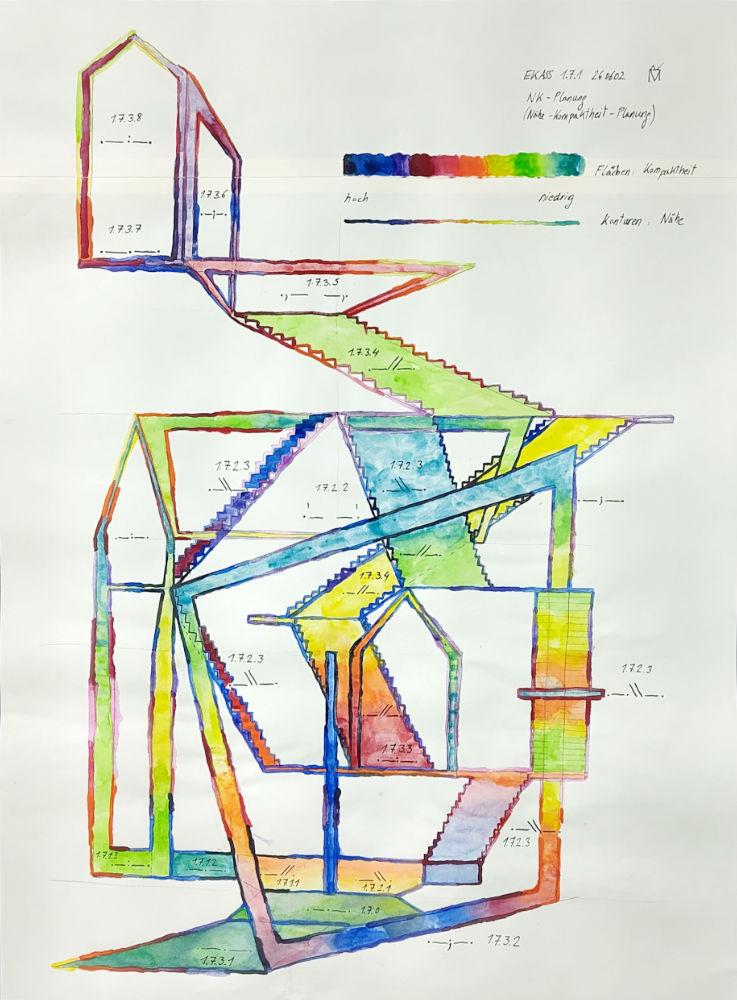
Eigenkontextuelle Architektur-Symbol-Sequenz 1.7.1 – Nähe-Kompaktheit-Planung
DIN A2, Mix-Technik (Bleistift, Fineliner, Aquarellfarben) Skizzenpapier, 2. Juni 2026, Kosmos Atlas Kartensammlung – EKASS 10 – Eigenkontextuelle Architektur-Symbol-Sequenzen
Der architektonische Inhalt des Bildes basiert auf Symbol-Notation der Eigenkontextuellen Architektur-Symbol-Sequenz 1 (EKASS-1). Durch diesen Bezug ist dieses Bild mit allen Werken, die sich auf die EKASS-1-Notation beziehen, verwandt.
Diese Arbeit dient als Unterstützung der dreidimensionalen Raum- und Funktionsgestaltung des Architekturentwurfes EKASS 1.7. Die farbigen Konturen stehen heben die ersichtlichen Naheverhältnisse der abgebildeten Architekturelemente der abgebildeten EKASS-Manifestation ab: Blau: große Nähe, Rot: mittlere Nähe, Grün-Türkis: geringe Nähe. Auf diesen Nähenverhältnissen aufbauend, ist, zur Planung der Kompaktheit der Teilstrukturen, die Färbung der Flächen zwischen den Konturen entstanden: Blau: hohe Kompaktheit, Rot: mittlere Kompaktheit, Grün-Türkis: niedrige Kompaktheit.
Self-contextual Architecture-Symbol-Sequence 1.8
Self-contextual Architecture-symbol-sequence 1.7.1 – Near-compactness-plan, DIN A2, mixed media (pencil, fineliner, water color) sketch paper, 2. June 2026, Kosmos atlas map collection – EKASS 10 – Self-contextual architecture symbol sequences
The architectural content of the image is based on the symbolic notation of the Self-referential architecture-symbol-sequence 1 (EKASS-1). As a result, this image is related to all works that refer to the EKASS-1 notation.
This work serves to illustrate the three-dimensional spatial and functional layout of the architectural design EKASS 1.7. The coloured outlines highlight the apparent proximity of the architectural elements depicted in the EKASS design: blue: close proximity; red: medium proximity; green-turquoise: slight proximity. Based on these proximity relationships, the areas between the contours have been colour-coded to indicate the compactness of the substructures: blue: high compactness; red: medium compactness; green-turquoise: low compactness.