EKASS: Self-contextual Architecture Symbol Sequences
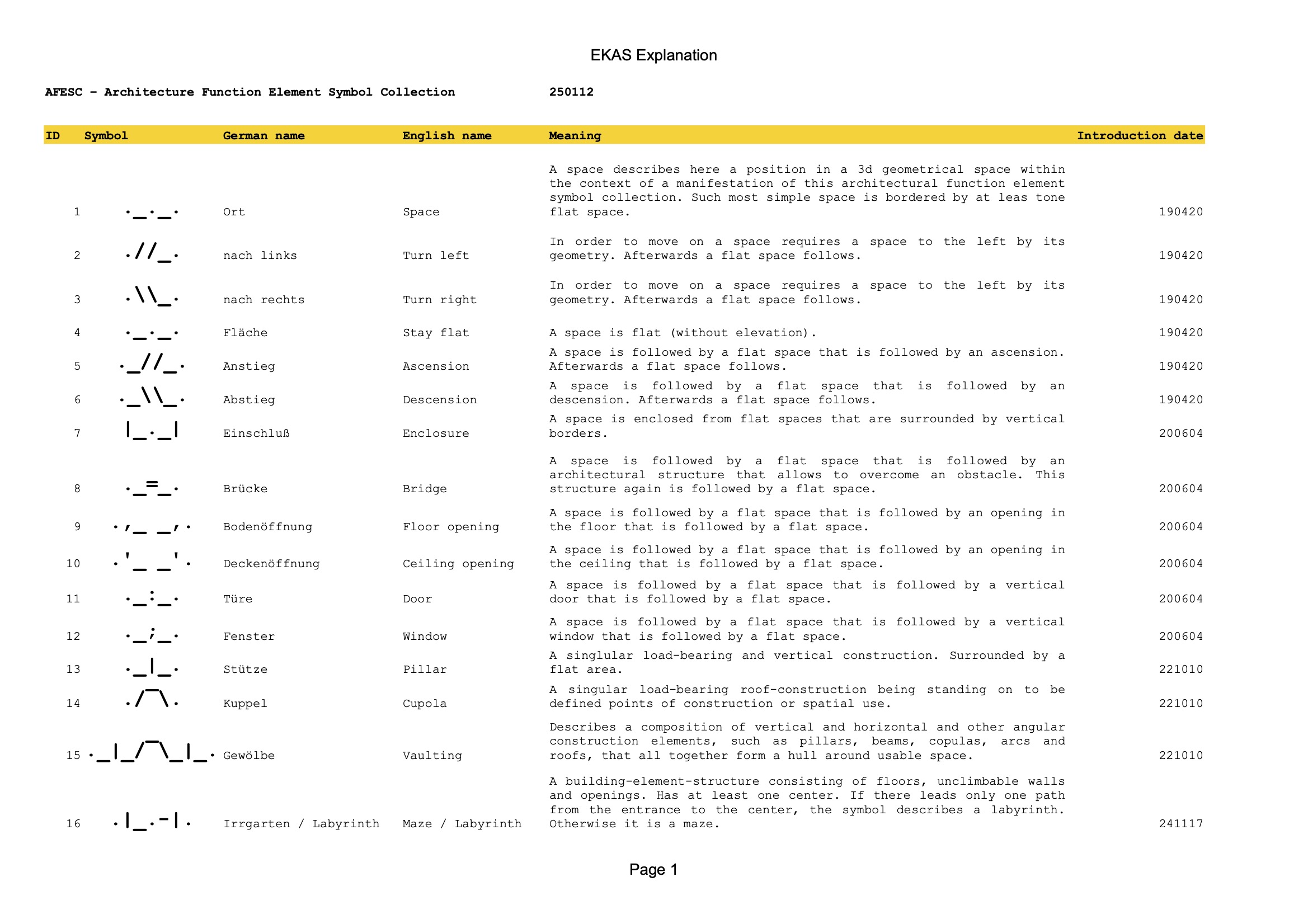
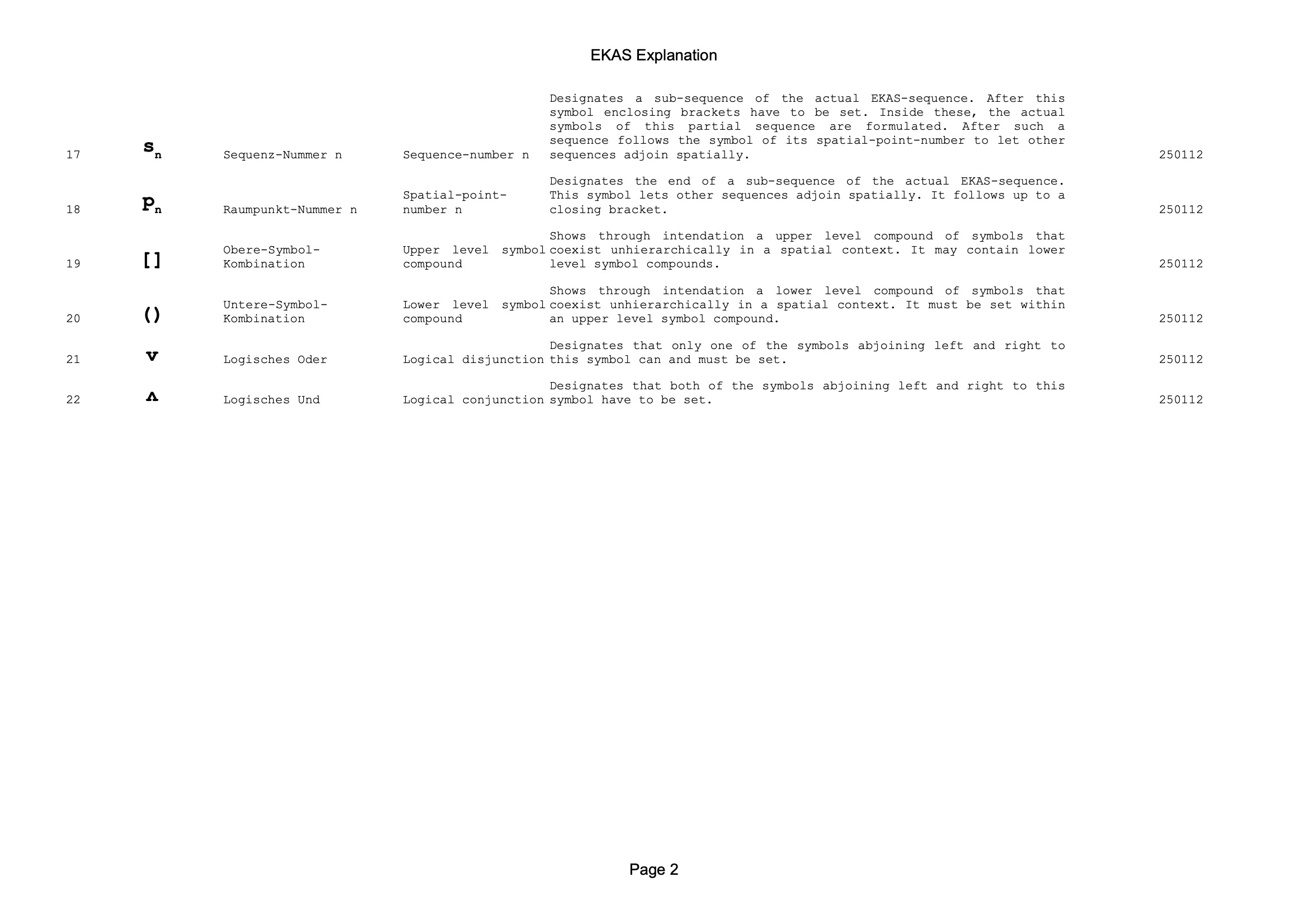
The notation of Self-contextural architecture symbol sequences (EKASS) was invented by Martin Ritzinger in 2021. It allows architectural elements – such as floors, walls, openings – to be formulated as sequences that are topologically bound but geometrically undefined. An overview list of the symbols used in this notation can be found below.
The EKASS notation does not accept any further information about the sequentially arranged architectural elements (form, construction, geometry, sizes, materials, etc.).
Following a created sequence, any number of variations of this sequence can be created in the domains of architectural design, visual arts, writing, music composition, etc. Thus, once created, each self-contextual architectural symbol sequence connects all variations based on it.
In addition to its use as an abstract architectural design tool, the EKASS notation can be used by hand in the context of building surveys or building inspections.
EKASS Notation explatation
(English symbol names, German elaboration).
 Martin Ritzinger